
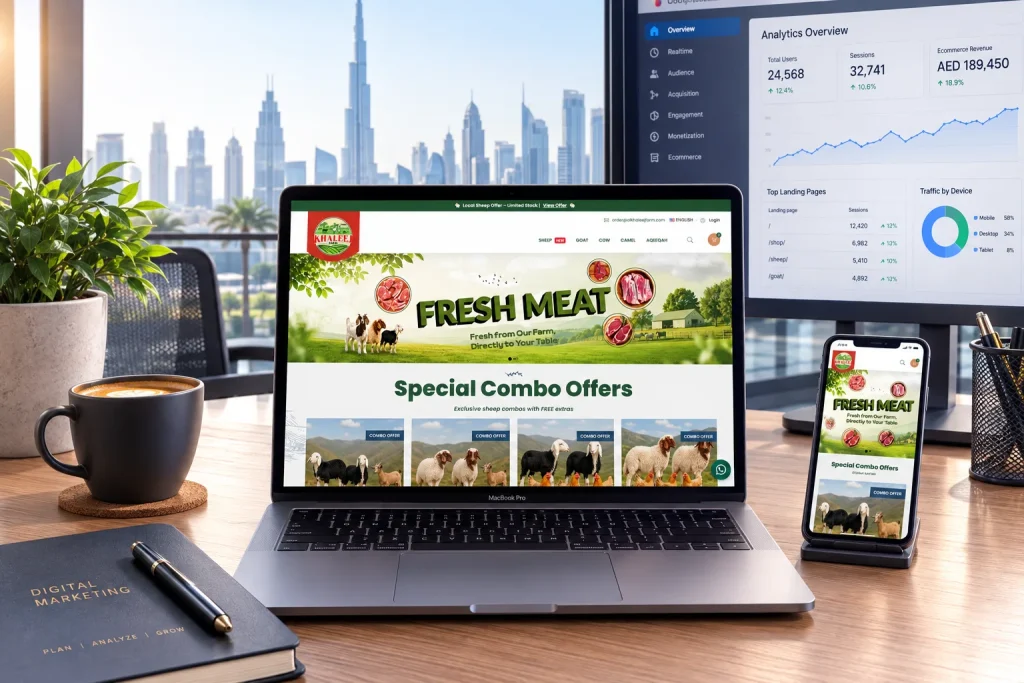
How I Optimized a WooCommerce Website for Better SEO and User Experience
WooCommerce SEO played an important role in improving the online visibility and user experience of Al Khaleej Farm’s eCommerce website. When I started working on Al Khaleej Farm, a UAE-based livestock and eCommerce business, one of the main goals was not simply to build a website that looked good, but to create a faster, more structured, and easier-to-use shopping experience for customers across the UAE.
The website needed to work as an important part of the business — helping customers discover products, understand their options, and complete their purchases with as little friction as possible.
Because the business operates in a competitive UAE eCommerce environment, the website needed to support both search visibility and customer experience.
That meant looking beyond individual product pages and considering the complete journey:
Google Search → Website → Product → Information → Checkout → Purchase
My work involved a combination of WooCommerce website optimization, SEO, content management, product optimization, user experience improvements, analytics, and digital marketing.
In this case study, I’ll explain some of the key areas I worked on and how I approached the optimization of the website.
1. Understanding the Business Before Optimizing the Website
Before making technical or SEO changes, it was important to understand what the business actually sells and how customers make purchasing decisions.
Al Khaleej Farm serves customers across the UAE with livestock and meat products, including sheep, goats, cows, and other offerings.
The website therefore needed to communicate information that is particularly important for this type of purchase, including:
- Product type
- Breed
- Age
- Weight
- Price
- Cutting options
- Delivery information
- Payment options
- Availability
- Special offers
This is important because eCommerce SEO isn’t just about adding keywords to a page.
The website needs to provide the information a potential customer is actually looking for.
WooCommerce itself provides product-management functionality for information such as product names, prices, descriptions, categories, attributes, variations and images. Providing useful product information also helps customers evaluate products more effectively.
2. Improving WooCommerce Product Pages
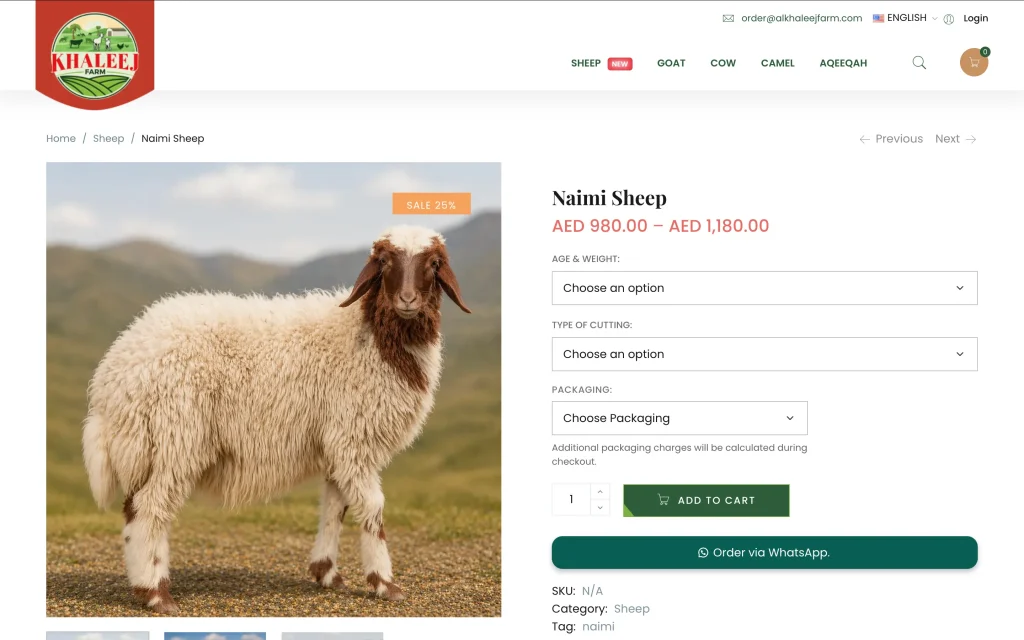
One of the first areas I focused on was WooCommerce SEO, including product structure, page content, metadata, internal linking, and technical improvements.
For an eCommerce website, product pages are often where search traffic can turn into potential customers.
A page may receive visitors through search, but if the product information is unclear or difficult to understand, that traffic may not result in meaningful engagement.
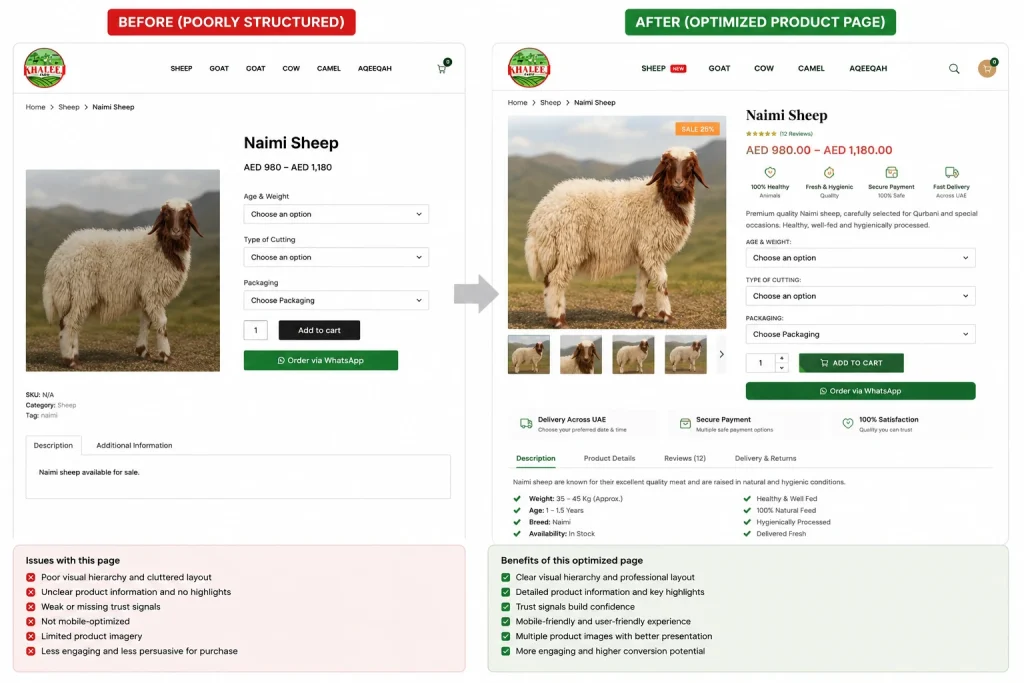
I worked on improving product information and organizing important details more clearly.
This included:
- Product titles
- Product descriptions
- Short descriptions
- Product categories
- Product attributes
- Product images
- Pricing information
- Weight and age information
- Cutting options
- Related products
- Internal links
The goal was to make product pages useful for both search engines and real customers.
Rather than treating SEO as simply inserting a target keyword repeatedly, I focused on making the product pages more informative and easier to navigate.
WooCommerce’s own documentation highlights the importance of product information, categories, attributes, images and other product data when managing an online store.
3. Building a Better Website Structure
Another important part of the optimization process was organizing the website around clear product categories and customer intent.
For an eCommerce business, customers don’t always search for a specific product immediately.
They may begin with a broader search such as:
“Goat for sale in UAE“
or:
“Naimi sheep price in Dubai“
The website therefore needs a logical structure that allows visitors to move from:
Search → Category → Product → Product Information → Checkout
I worked on improving the relationship between product categories, individual products, and supporting content.
This included organizing products into relevant categories and using internal links where appropriate.
A clear structure helps users discover related products while also making it easier for search engines to understand how different pages on the website relate to one another.
4. Improving SEO Across the Website
SEO was another major part of the optimization process.
Instead of focusing on a single keyword, I worked on improving different parts of the website around relevant search intent.
This included:
- Keyword research
- Product-page optimization
- Category-page optimization
- Meta titles
- Meta descriptions
- Heading structure
- Image alt text
- Internal linking
- Content optimization
- Technical SEO
- Structured data
- Search Console monitoring
For an eCommerce website, this creates multiple opportunities for search engines to understand the products and categories being offered.
I also focused on writing content naturally rather than forcing keywords into every section.
Google’s SEO guidance recommends creating useful, well-organized content that helps both users and search engines understand a website.
5. Optimizing Images and Product Presentation
Images play an important role in an eCommerce website.
For Al Khaleej Farm, product images needed to communicate the products clearly while maintaining a professional visual identity across the website.
I worked on areas such as:
- Image selection
- Image quality
- Image dimensions
- Image filenames
- Alt text
- Product image consistency
- Image placement
Image optimization isn’t simply about adding alt text.
Images should also be relevant, high quality and placed near the content they support.
Google’s SEO guidance recommends using high-quality images near relevant text and making them understandable to users and search engines.
6. Improving the User Experience
SEO can bring visitors to a website, but the website experience determines what happens next.
For Al Khaleej Farm, I therefore looked beyond search rankings and considered how customers interact with the website.
Some of the areas I focused on included:
- Navigation
- Product discovery
- Product information
- Mobile usability
- Product variations
- Checkout fields
- Delivery information
- Payment information
- Calls to action
- Overall page structure
The objective was to reduce unnecessary friction.
For example, when someone is purchasing livestock or meat online, information such as weight, age, cutting type, delivery options, and pricing needs to be easy to find.
A customer shouldn’t have to search through several pages just to understand what they’re buying.
This is where combining digital marketing with web development becomes particularly valuable.
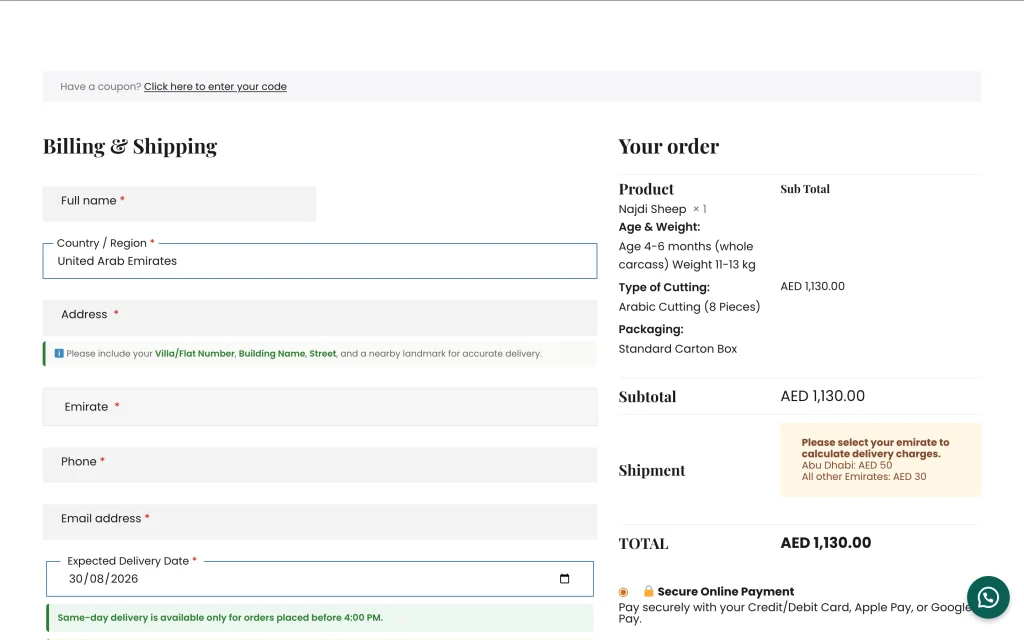
7. Optimizing the WooCommerce Checkout Experience
The checkout process was another area where website functionality and user experience came together.
For an eCommerce business serving customers across the UAE, delivery information is particularly important.
I worked on improving the checkout experience by incorporating information and fields related to:
- Expected delivery date
- Delivery time slots
- Emirates
- Delivery charges
- Order information
- Customer details
The objective was to make the checkout process clearer while collecting the information needed to process and deliver orders efficiently.
A good checkout shouldn’t simply collect information from the customer.
It should also reassure customers that the ordering process is clear and predictable.
8. Mobile Experience Matters
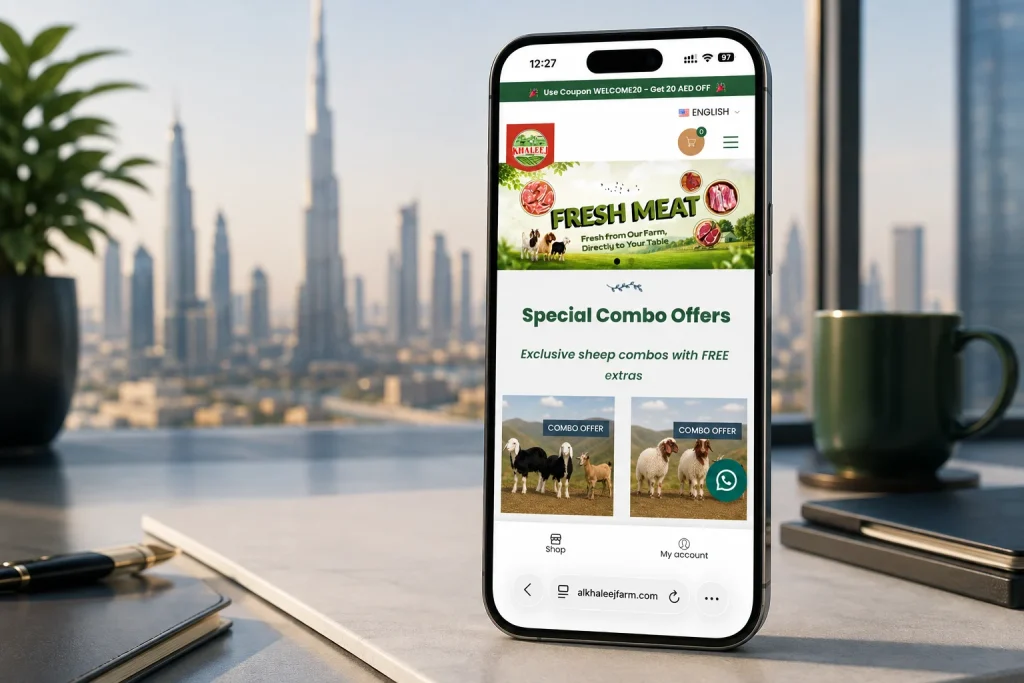
A significant part of modern website optimization involves mobile users.
Customers increasingly discover businesses, browse products, and make purchasing decisions from smartphones.
That means an eCommerce website cannot be designed only for desktop screens.
I reviewed the website across different screen sizes and worked on areas such as:
- Mobile navigation
- Product layouts
- Product information
- Buttons
- Forms
- Checkout
- Content spacing
- Image presentation
- Responsive layouts
Google uses the mobile version of a site’s content for indexing and ranking, so ensuring that the important content and functionality are available on mobile is essential.
9. Connecting SEO With Digital Marketing
Another important part of the project was making sure the website wasn’t operating in isolation.
The website became part of a wider digital marketing strategy involving:
- SEO
- Google Ads
- Meta Ads
- Social media marketing
- Content
- Product promotions
- Analytics
For example, paid advertising can bring targeted visitors to specific products or offers, while SEO can build longer-term organic visibility.
Social media can then help create awareness and engagement, while the website provides the platform where customers can explore products and complete their purchases.
This creates a more connected digital ecosystem rather than relying on a single marketing channel.
10. Using Analytics to Understand Website Performance
Optimization shouldn’t stop once changes are implemented.
I also used analytics and measurement tools to better understand how users interact with the website.
Tools and platforms involved included:
- Google Analytics
- Google Search Console
- Google Tag Manager
- SEO tools
- Website analytics
These tools help answer questions such as:
- Which pages attract visitors?
- Which products receive attention?
- How are users finding the website?
- Which search queries generate visibility?
- Where might users be dropping off?
- Which marketing channels are driving traffic?
Google Search Console provides reports on search traffic, impressions, clicks and search position, making it useful for monitoring how a website performs in Google Search.
11. Combining Web Development and Digital Marketing
One of the biggest lessons from this project was how closely web development and digital marketing are connected.
A marketer may identify an SEO or conversion problem, but solving it may require changes to the website.
A developer may improve a website technically, but without understanding search intent and customer behavior, those improvements may not produce meaningful business results.
My background in both software development and digital marketing allows me to approach these projects from both perspectives.
I can look at a website and ask:
Is it technically working?
But I can also ask:
Can customers find it?
Can they understand the products?
Is the user experience clear?
Does the website support the marketing strategy?
Does the journey from search to purchase make sense?
That combination is what I believe makes website optimization much more effective.
12. The Result: A More Complete Digital Experience
The goal of the Al Khaleej Farm project was not simply to make a website “more SEO friendly.”
The broader objective was to create a stronger digital foundation for the business.
Through a combination of WooCommerce optimization, SEO, content improvements, website development, analytics, advertising, and user-experience improvements, the website became better aligned with the needs of both the business and its customers.
The project also demonstrated the value of treating a website as more than a digital brochure.
For an eCommerce business, the website is part of the sales process.
It needs to attract the right visitors, communicate product information clearly, create trust, provide a smooth browsing experience, and make it easy for customers to take action.
What I Learned From the Project
Working on Al Khaleej Farm reinforced something that I believe is important for modern digital marketing:
SEO, web development, and user experience shouldn’t be treated as separate disciplines.
A technically strong website with poor content may struggle to attract the right audience.
A well-ranked website with a confusing user experience may struggle to convert visitors.
And a beautiful website without a clear SEO and marketing strategy may struggle to be discovered in the first place.
The best results come when these elements work together.
That’s the approach I continue to bring to the websites and digital marketing projects I work on.
Conclusion
Optimizing a WooCommerce SEO website is much more than changing a few keywords or installing an SEO plugin.
My work on Al Khaleej Farm involved looking at the website as a complete digital experience — from search visibility and product structure to user experience, checkout, analytics, advertising, and content.
The project gave me the opportunity to combine my experience in digital marketing and web development to solve practical business problems for a UAE-based eCommerce brand.
For businesses investing in eCommerce, I believe the website should do more than simply exist online. It should help customers discover the business, understand its products, and move confidently toward a purchase.
That’s ultimately what good WooCommerce optimization should achieve: a website that is easier to find, easier to use, and better aligned with business goals.
FAQ
What is WooCommerce SEO?
WooCommerce SEO is the process of optimizing an online store built with WooCommerce so that search engines can better understand its products, categories, content, and website structure while providing a useful experience for customers.
Why is SEO important for a WooCommerce website?
SEO can help an eCommerce website attract relevant organic visitors who are actively searching for its products or services. Good SEO also improves the way products and categories are structured and presented to users.
What did you optimize on the Al Khaleej Farm website?
I worked across several areas including WooCommerce product pages, SEO, website structure, product information, content, image optimization, user experience, checkout functionality, analytics, and digital marketing.
Can SEO and web development be handled together?
Yes. Combining SEO and web development can be particularly useful because many SEO and user-experience improvements require changes to the website itself.
Does WooCommerce SEO help businesses in the UAE?
Yes. A well-structured WooCommerce website can target relevant search intent and location-specific audiences while providing customers with clearer product information and a better online shopping experience.
Need Help Optimizing Your Website?
If your website is attracting visitors but isn’t turning enough of them into enquiries or customers, the problem may not be your traffic alone.
I help businesses improve their SEO, WordPress websites, WooCommerce stores, and digital marketing strategies with a focus on practical, measurable improvements.
Let’s discuss your website and identify opportunities for improvement.